Fruiting Chamber Environment: Temperature, Humidity, and FAE
Everything you need to know about Fruiting Chamber Environment: Temperature, Humidity, and FAE — from materials to first harvest.
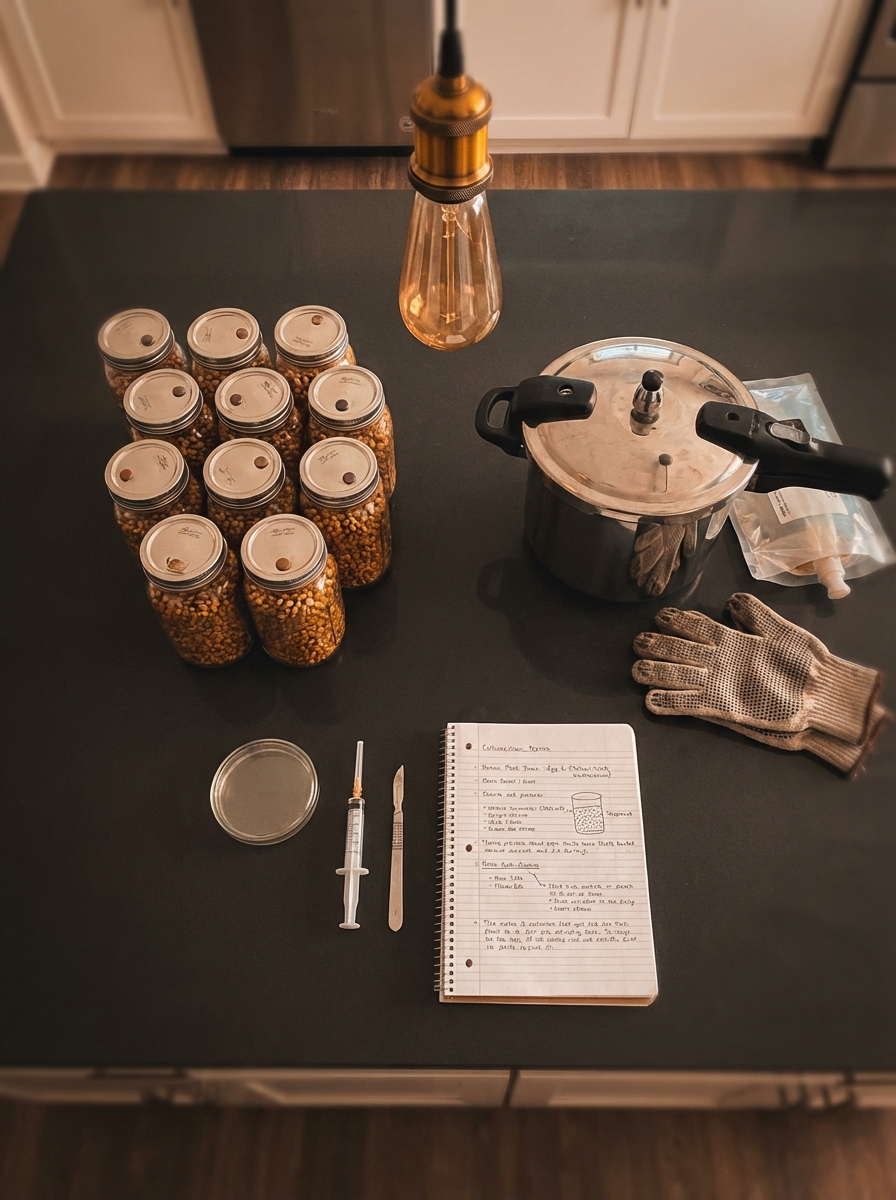
What You'll Need
- See full supply list in guide below.
Find grow supplies at vendors in our Directory.
Step-by-Step Process
Fruiting Chamber Environment: Temperature, Humidity, and FAE
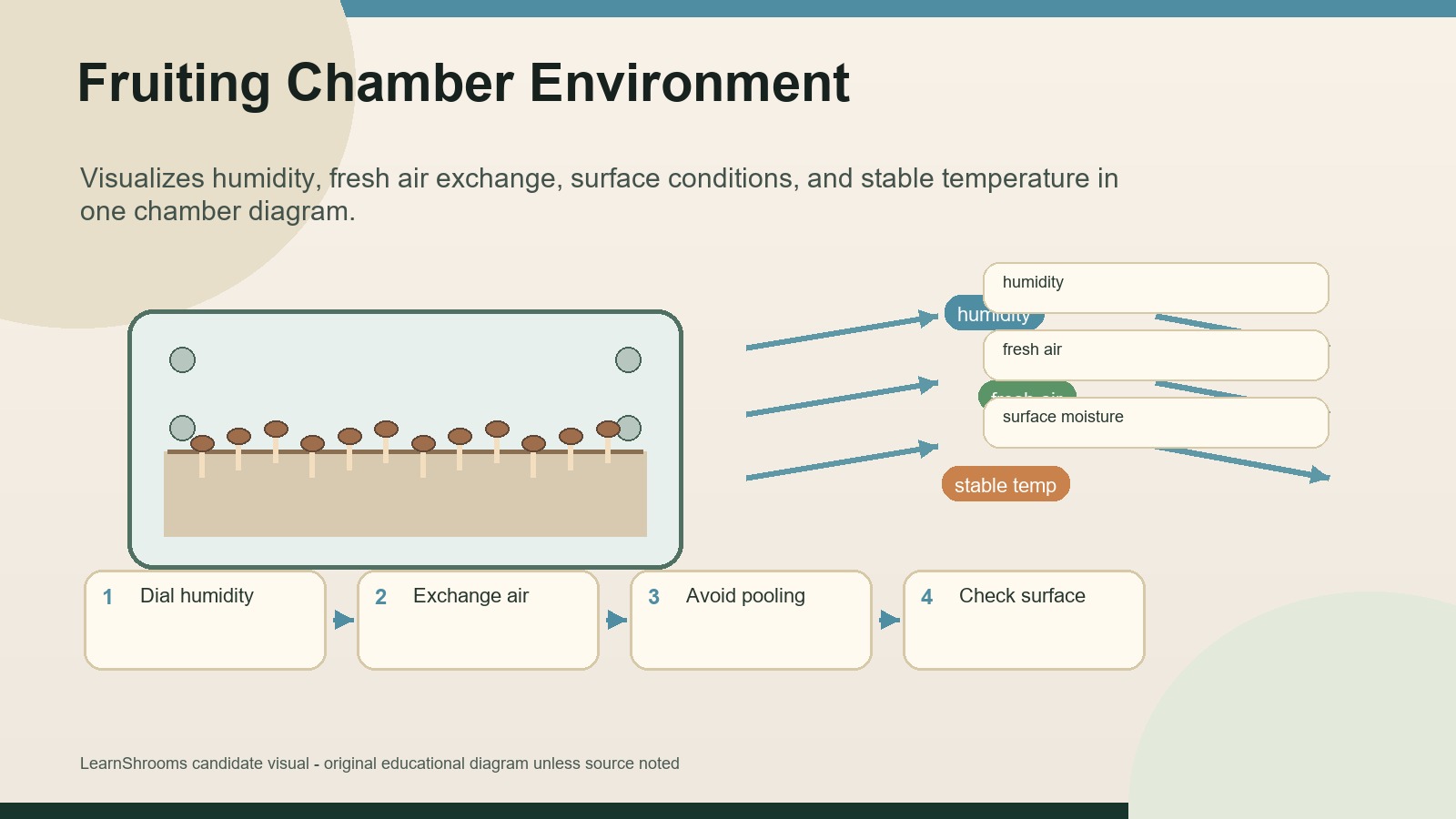
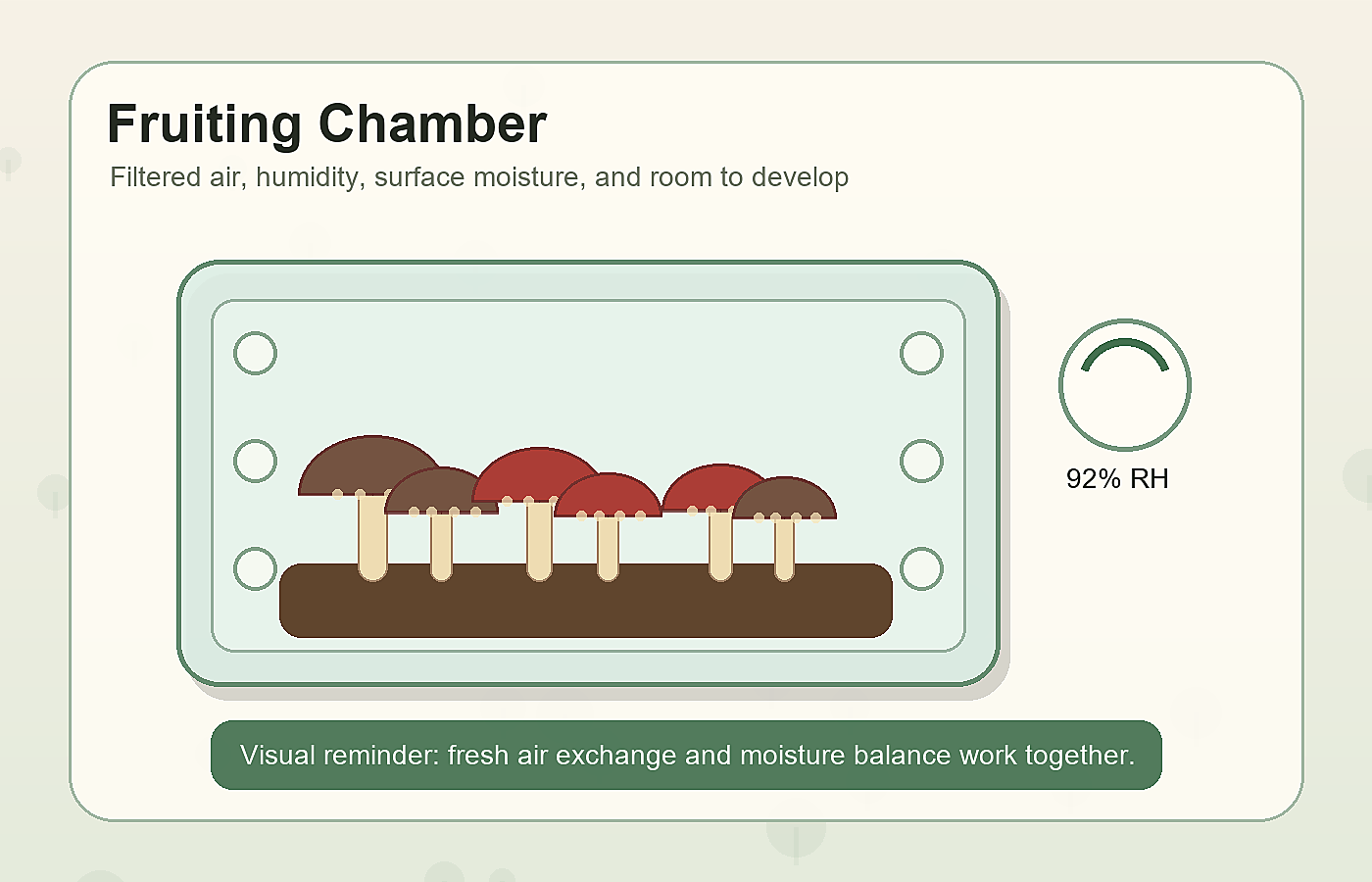
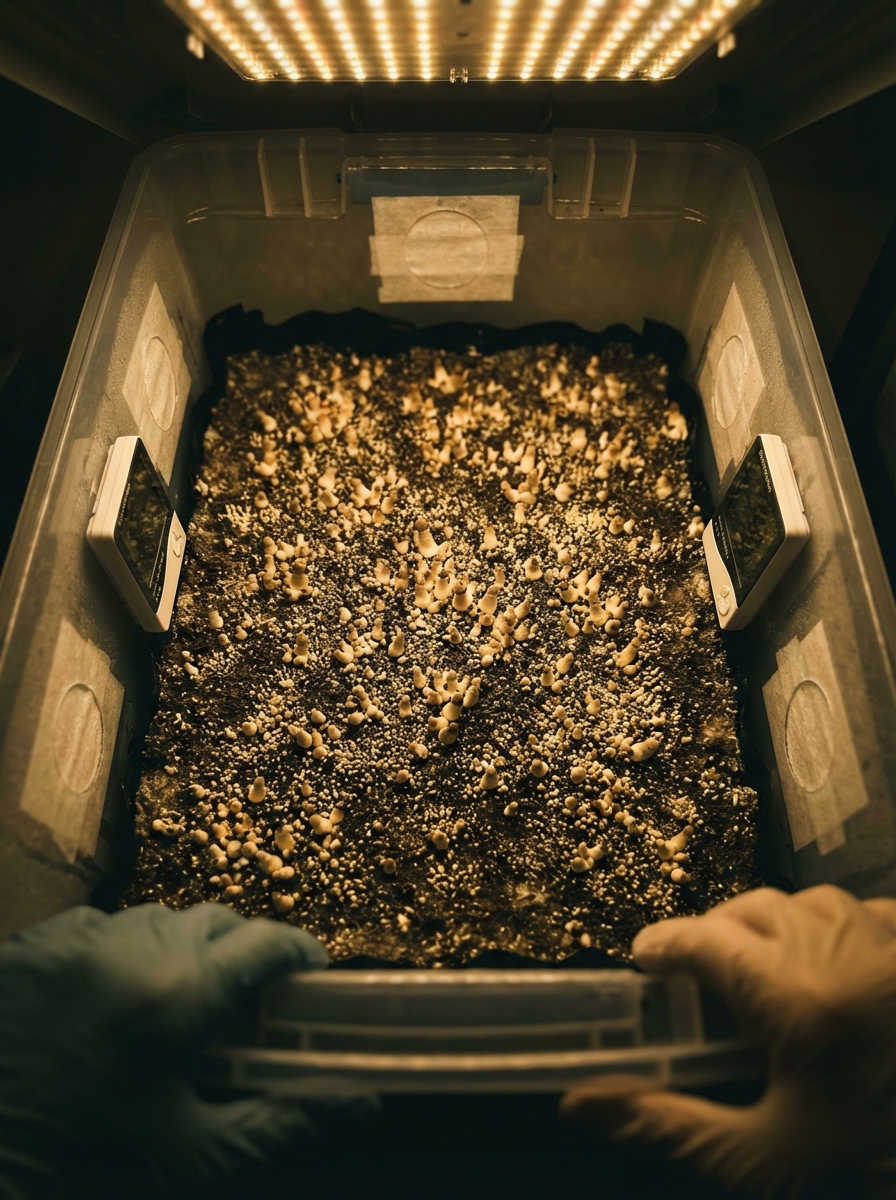
The fruiting chamber is where mushrooms develop from pinset through harvest — and where most yield problems occur. Mycelium will tolerate imperfect conditions during colonization; developing fruit bodies are far less forgiving. Understanding and controlling the three core environmental variables — temperature, humidity, and fresh air exchange (FAE) — is the difference between sparse, aborted fruits and dense, well-developed flushes.
Environment Triage Card
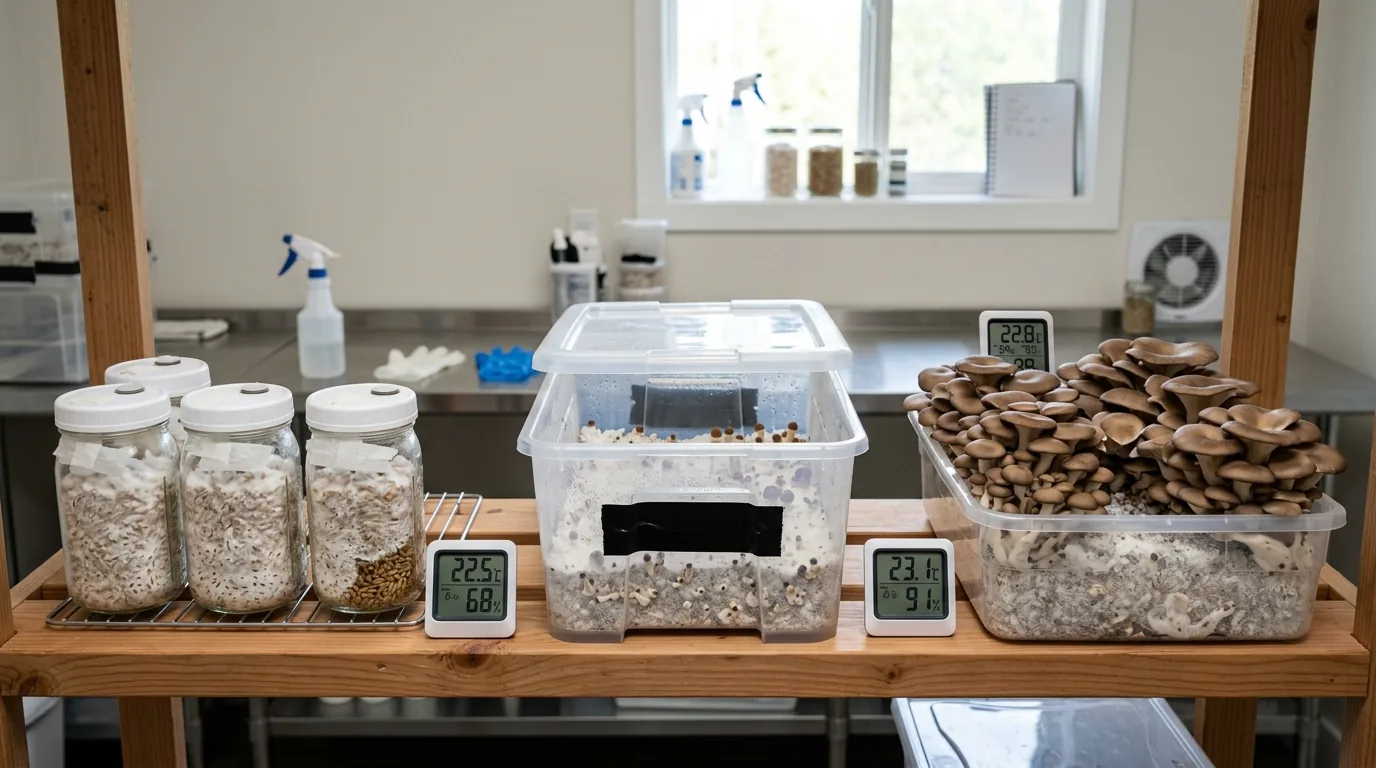
When a fruiting chamber drifts, fix the simplest visible cause first:
- Dry surface: Raise humidity or mist the chamber walls lightly; avoid soaking pins or pooling water.
- Tall stems, small caps: Increase fresh-air exchange in short, repeatable intervals.
- Wet or sour substrate: Reduce misting, increase air exchange, isolate the tub, and discard if contamination signs spread.
- No pins: Check legal species choice, full colonization, surface moisture, temperature, and air exchange before changing multiple variables at once.
The Three Variables and Their Interactions
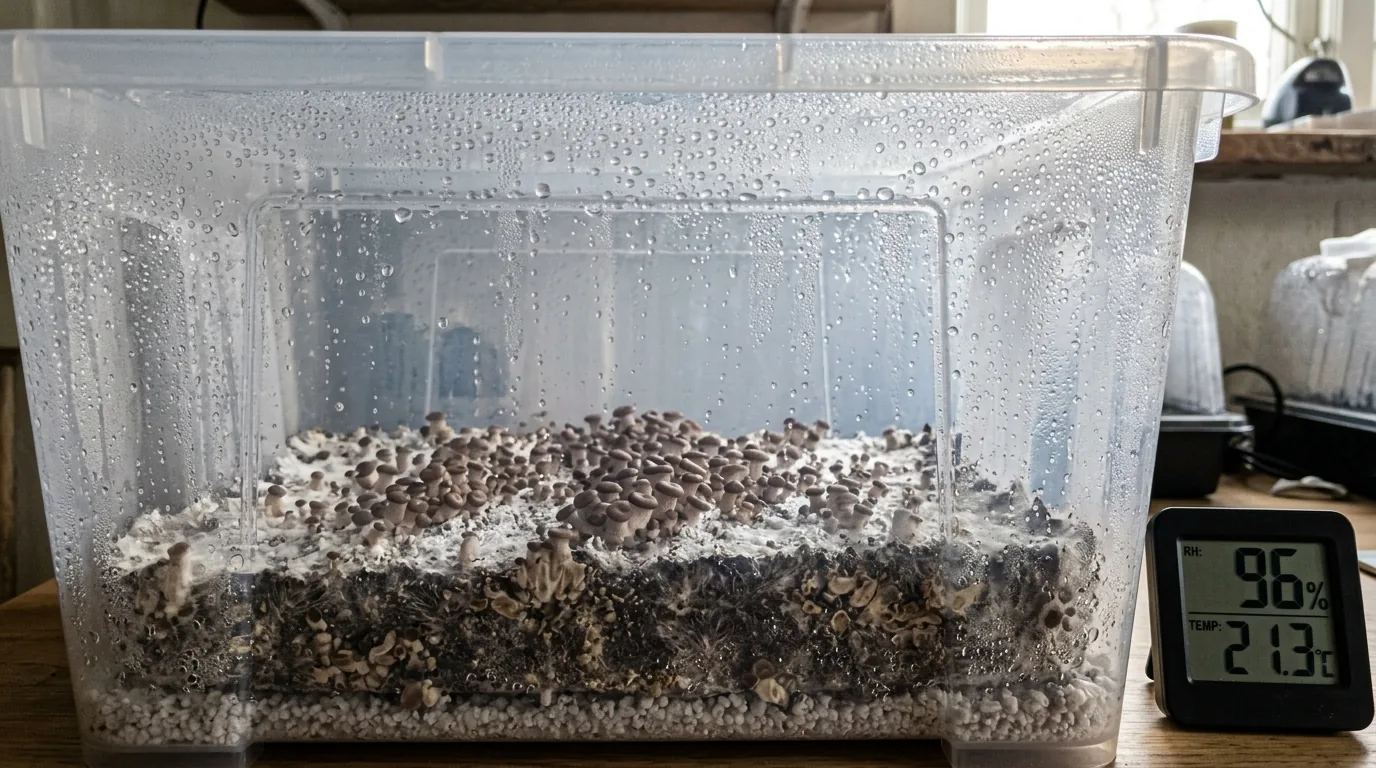
Temperature, humidity, and FAE are not independent variables — they interact continuously. Temperature affects evaporation rate (which affects humidity). FAE events drop humidity and temperature. Misting affects both surface humidity and temperature. Understanding these interactions is more important than optimizing any single variable.
The goal is a stable environment within the optimal ranges, not constant active management. A fruiting chamber that maintains conditions passively (through its design) requires far less intervention than one that needs constant attention.
Temperature
Optimal Ranges for Psilocybe cubensis
Colonization: 75-80°F (24-27°C) — the mycelium prefers warmth for the most active growth
Fruiting: 70-75°F (21-24°C) — slightly cooler temperatures encourage pinning and produce denser, more compact fruits
Cold shocking for initiation: 55-65°F (13-18°C) for 12-24 hours — a deliberate temperature drop that triggers pinning in consolidated substrate
Temperature Sources and Control
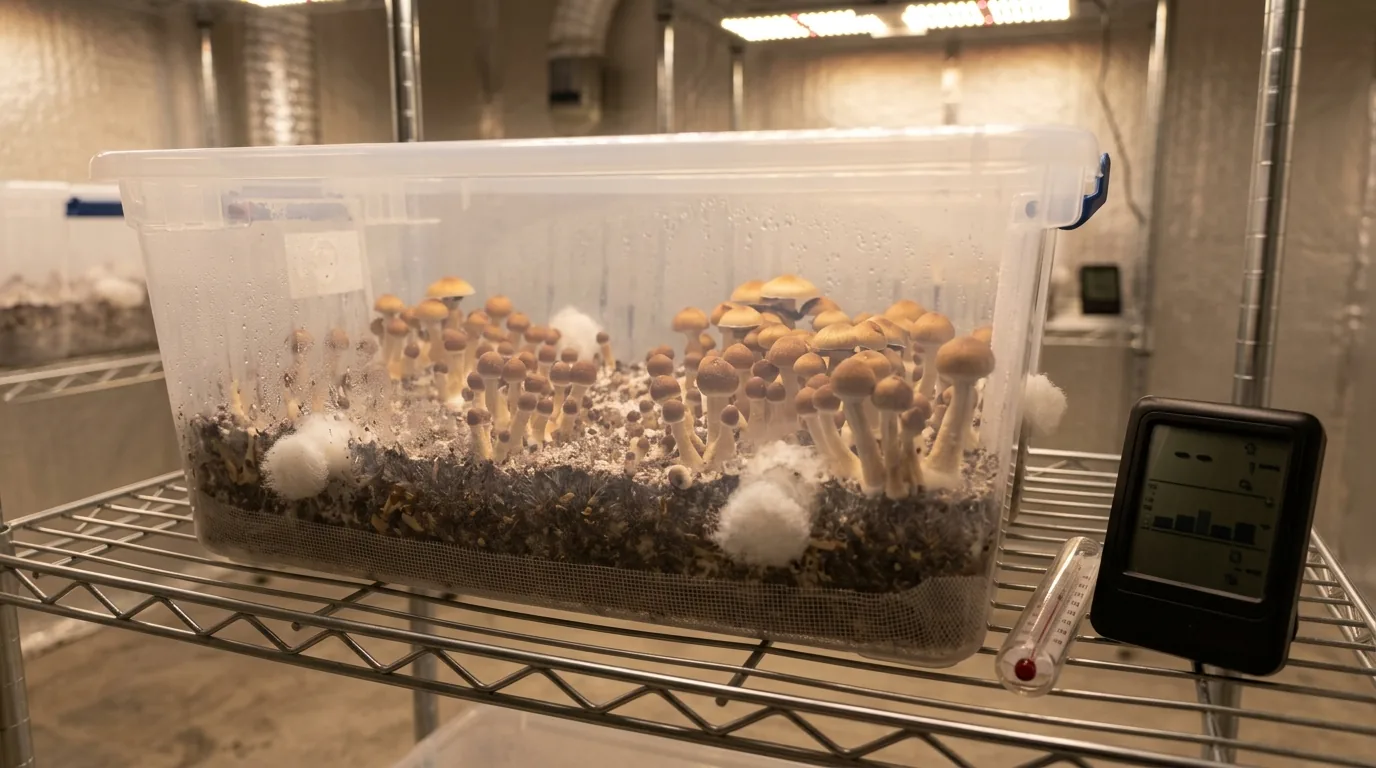
Passive room temperature: If your grow space naturally stays in the 70-75°F range, no active heating or cooling is needed during fruiting. This is the simplest solution.
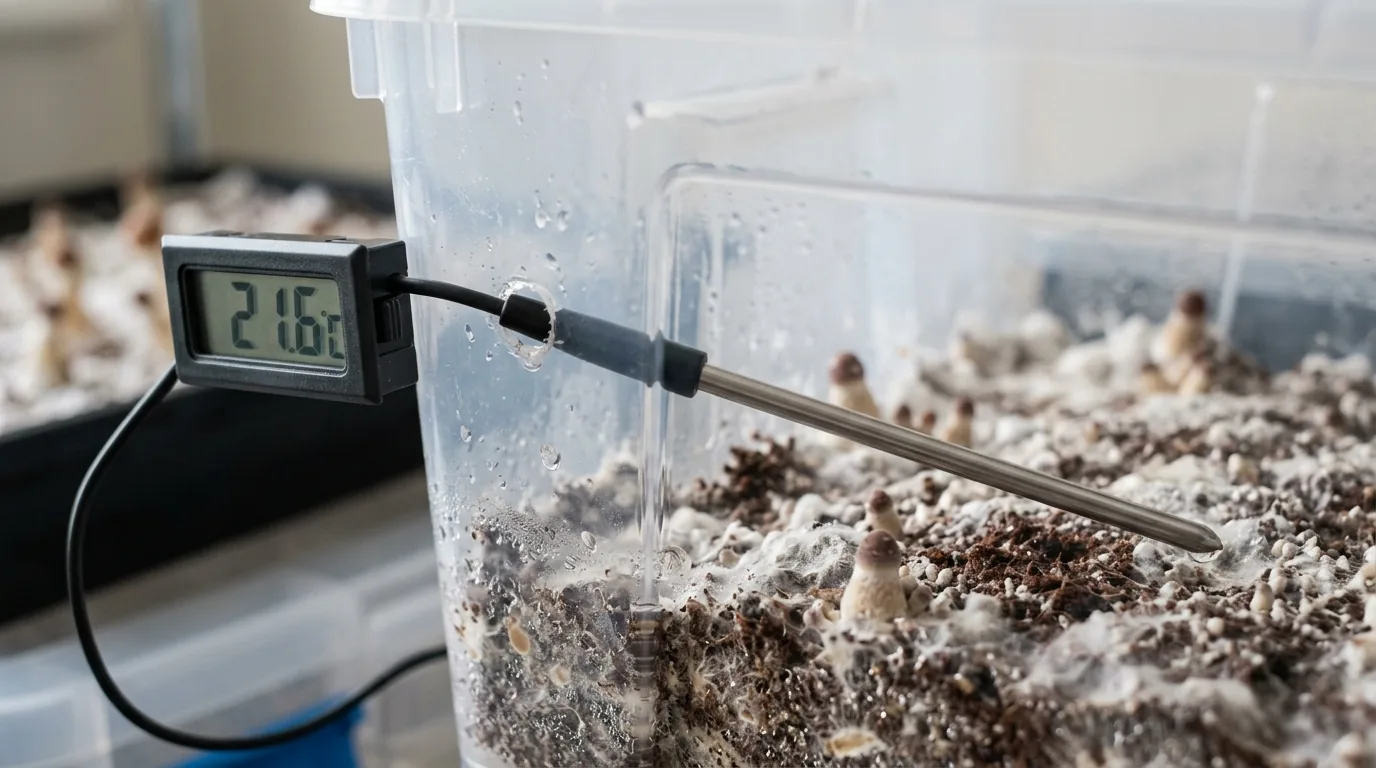
Heat mats (under-tub): For grows that need additional warmth, reptile heat mats or seedling heat mats positioned under the tub maintain substrate temperature above room temperature. Use a thermometer probe to monitor actual substrate temperature — the mat surface can be significantly hotter than the substrate it warms.
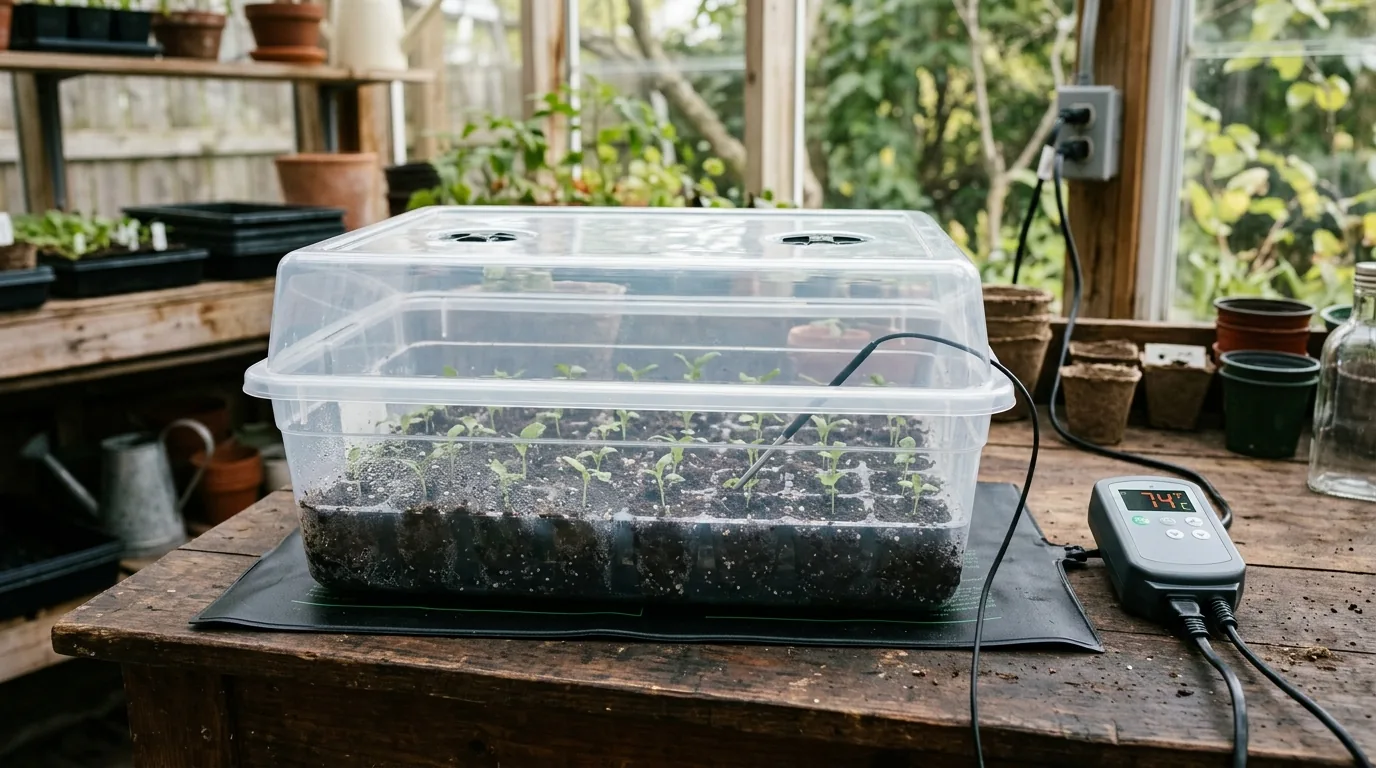
Seed germination mats with thermostatic controller: A dedicated controller (Inkbird, Ranco) allows precise temperature maintenance by switching the heat mat on and off. A probe in the substrate provides feedback to the controller. This setup is the most reliable active temperature control for small home grows.
Avoiding temperature extremes:
- Above 85°F (29°C): Inhibits fruiting, encourages bacterial contamination, can permanently damage mycelium
- Below 60°F (15°C) during fruiting (outside of intentional cold shocking): Severely slows or halts fruit development; doesn't typically damage mycelium but creates aborts
Temperature Measurement
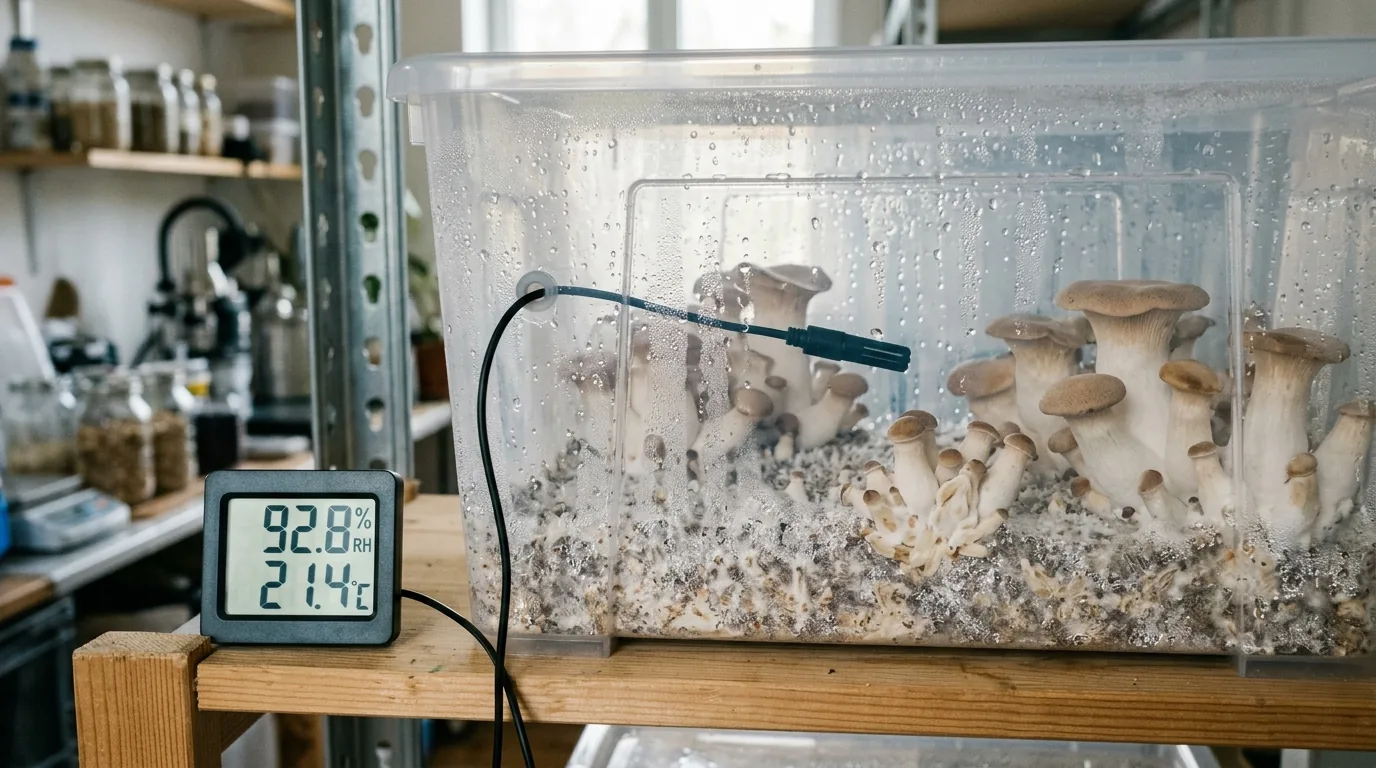
Never rely solely on room air temperature. Substrate temperature inside a tub can differ significantly from ambient — especially when heat mats are used. A digital probe thermometer with the probe inside the tub is the only accurate measurement.
Humidity
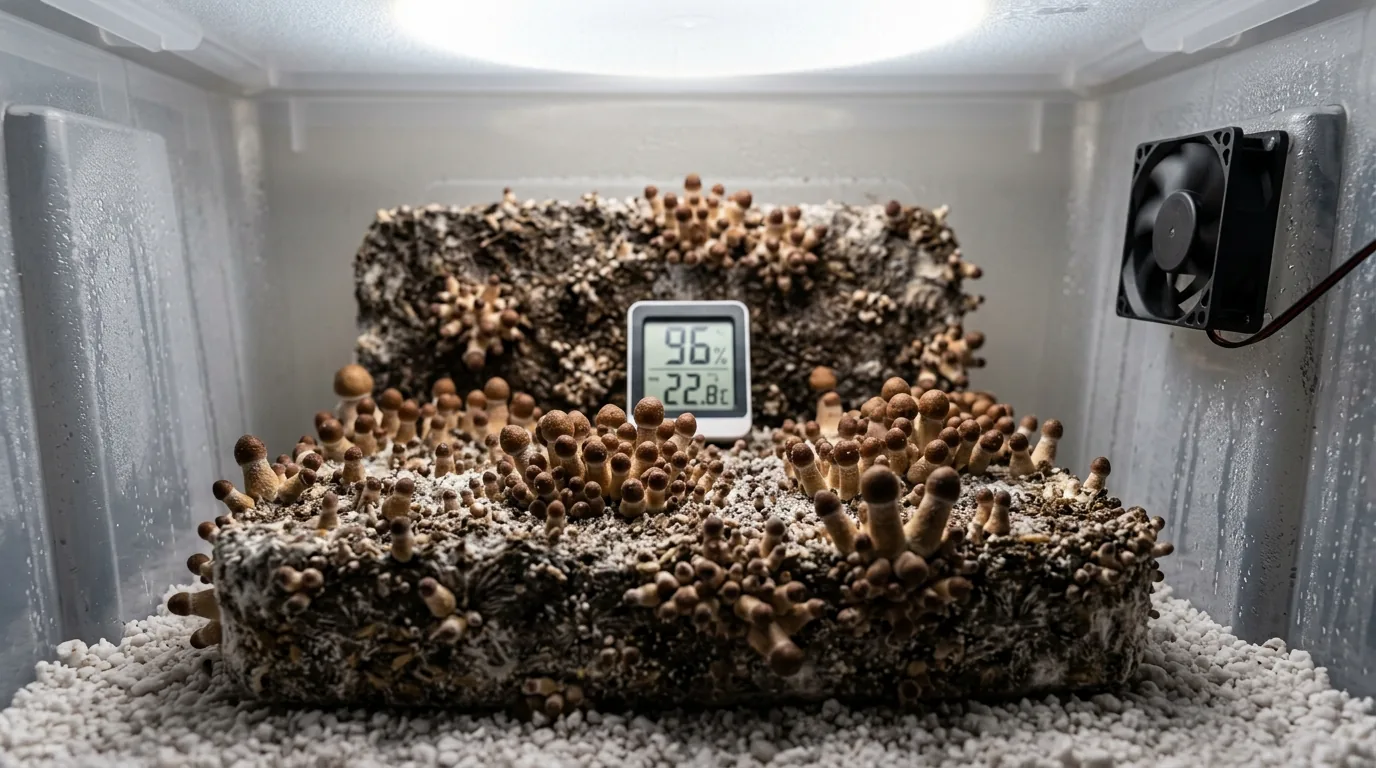
Why Humidity Matters So Much
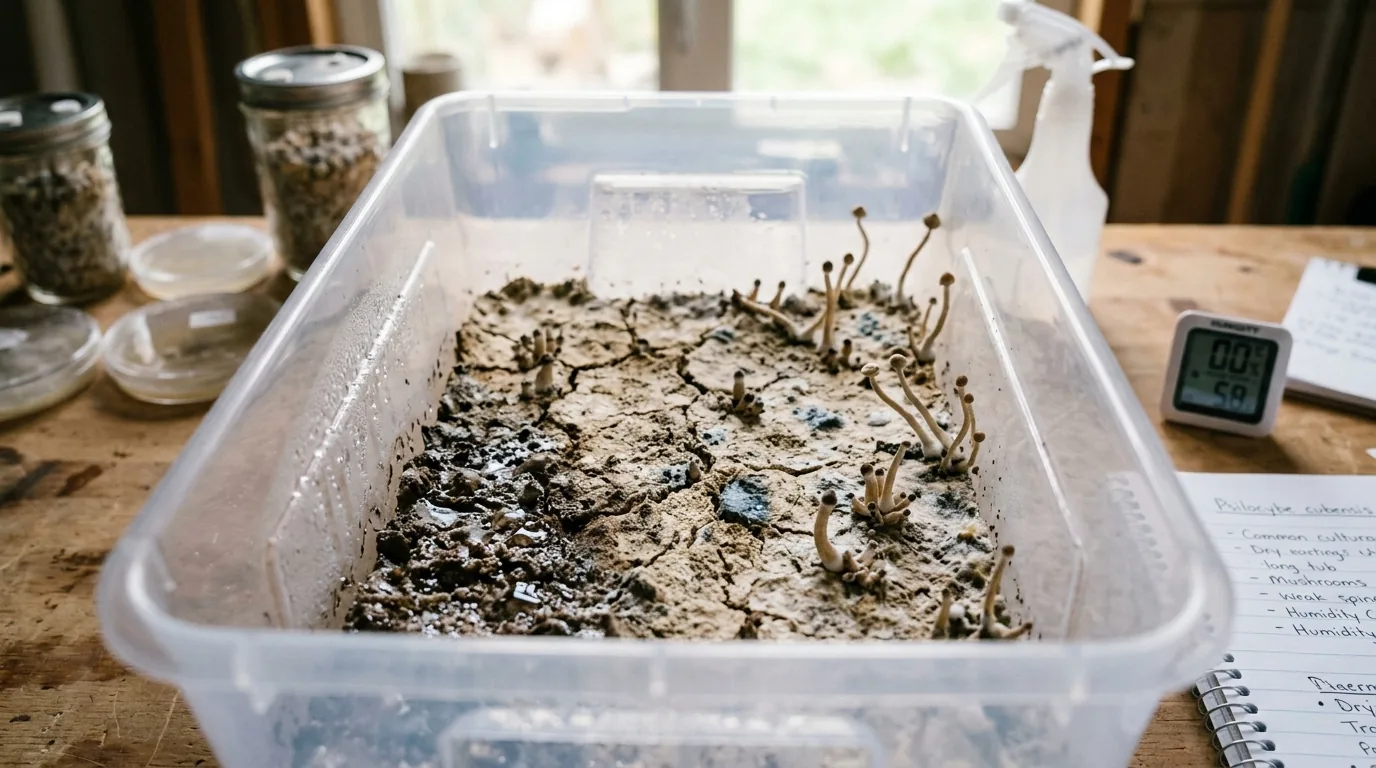
Developing mushroom fruit bodies are 85-90% water by weight. They lose moisture rapidly to the surrounding air through their surfaces. If the relative humidity in the fruiting chamber drops significantly below 90%, developing fruits can't maintain the hydration they need for proper development and will abort.
Beyond abort prevention, humidity affects:
- Pin initiation rate (higher humidity at the substrate surface supports denser pinsets)
- Cap development (proper humidity produces broad, well-developed caps; low humidity produces tight, underdeveloped caps)
- Stem thickness and height (CO2 effects interact with humidity to determine fruit morphology)
Optimal Humidity Range
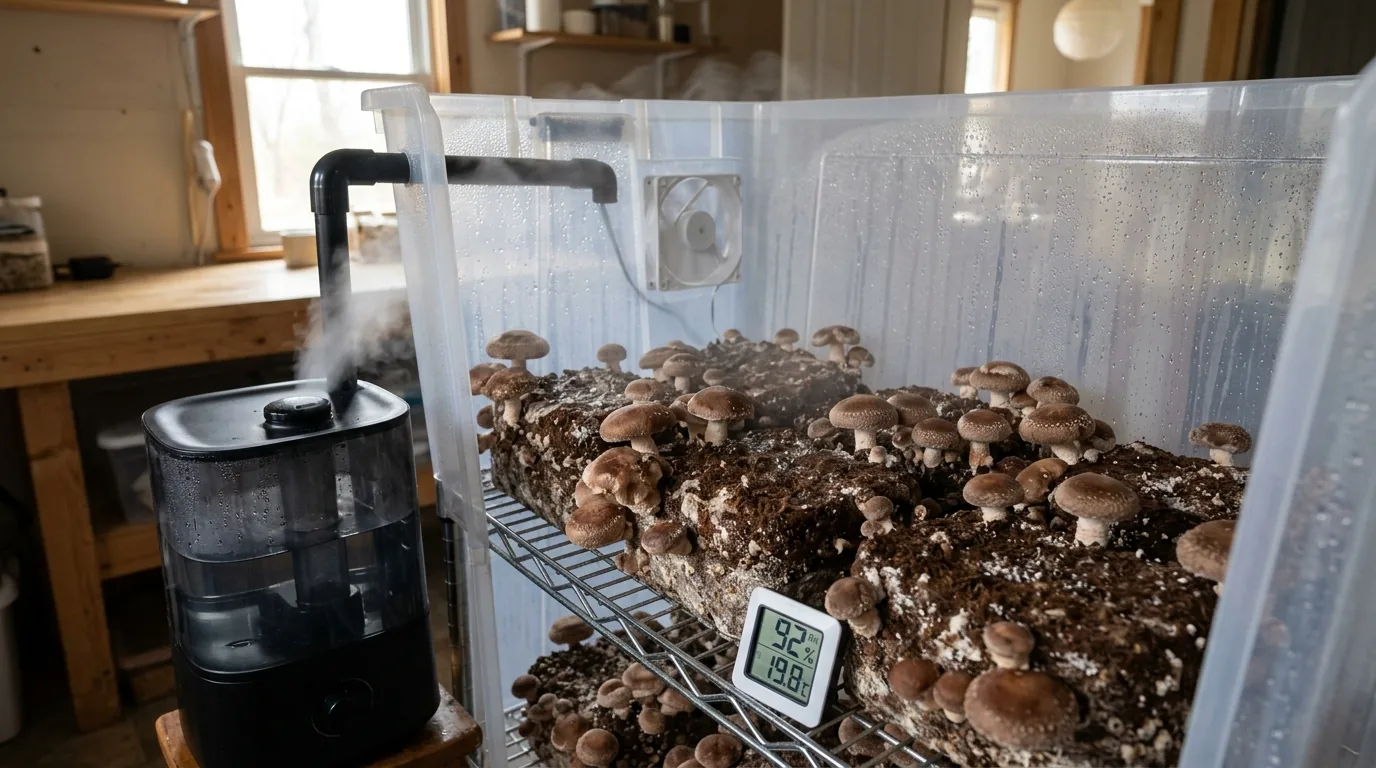
90-95% relative humidity for most Psilocybe cubensis cultivation.
Above 95%: Risk of bacterial wet rot; pins may not form properly due to insufficient vapor pressure differential.
Below 85%: Abort risk becomes significant; pinning density decreases.
Humidity Measurement
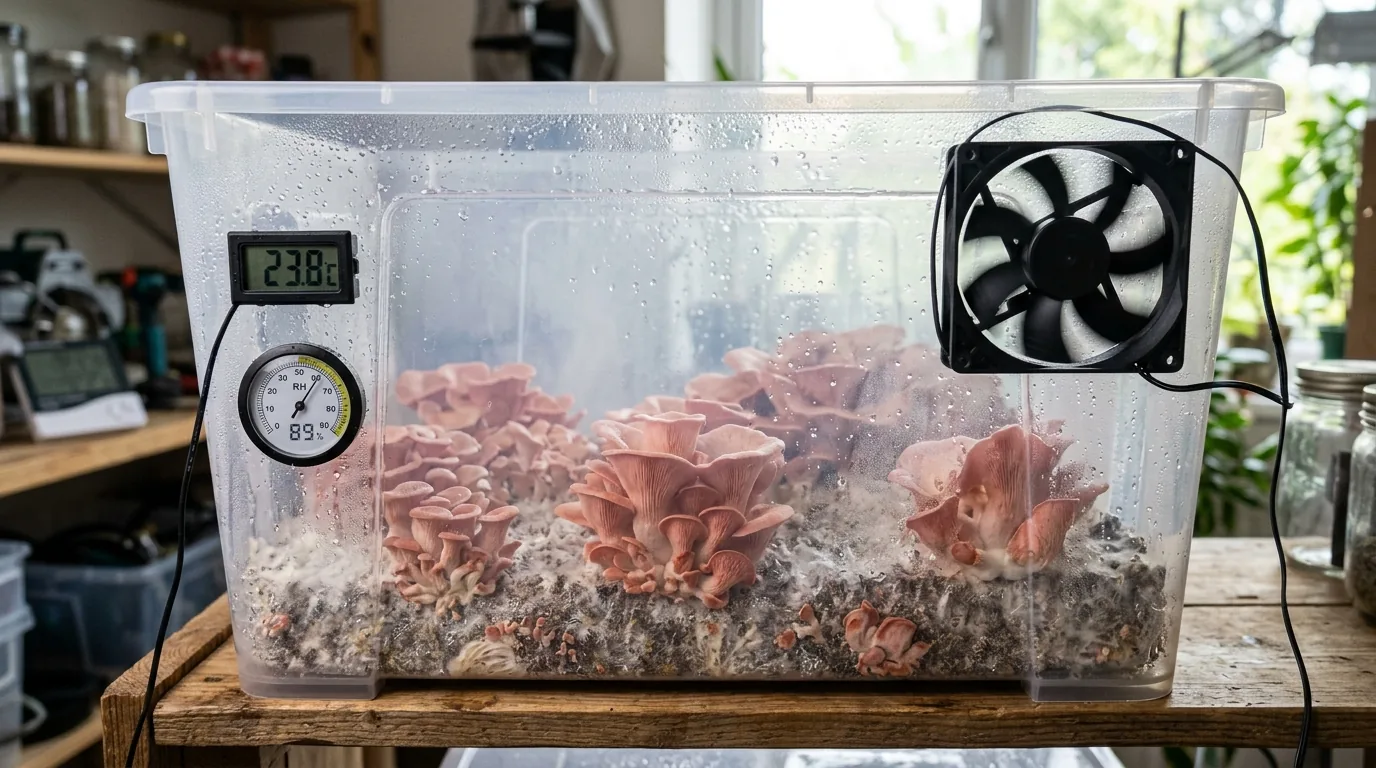
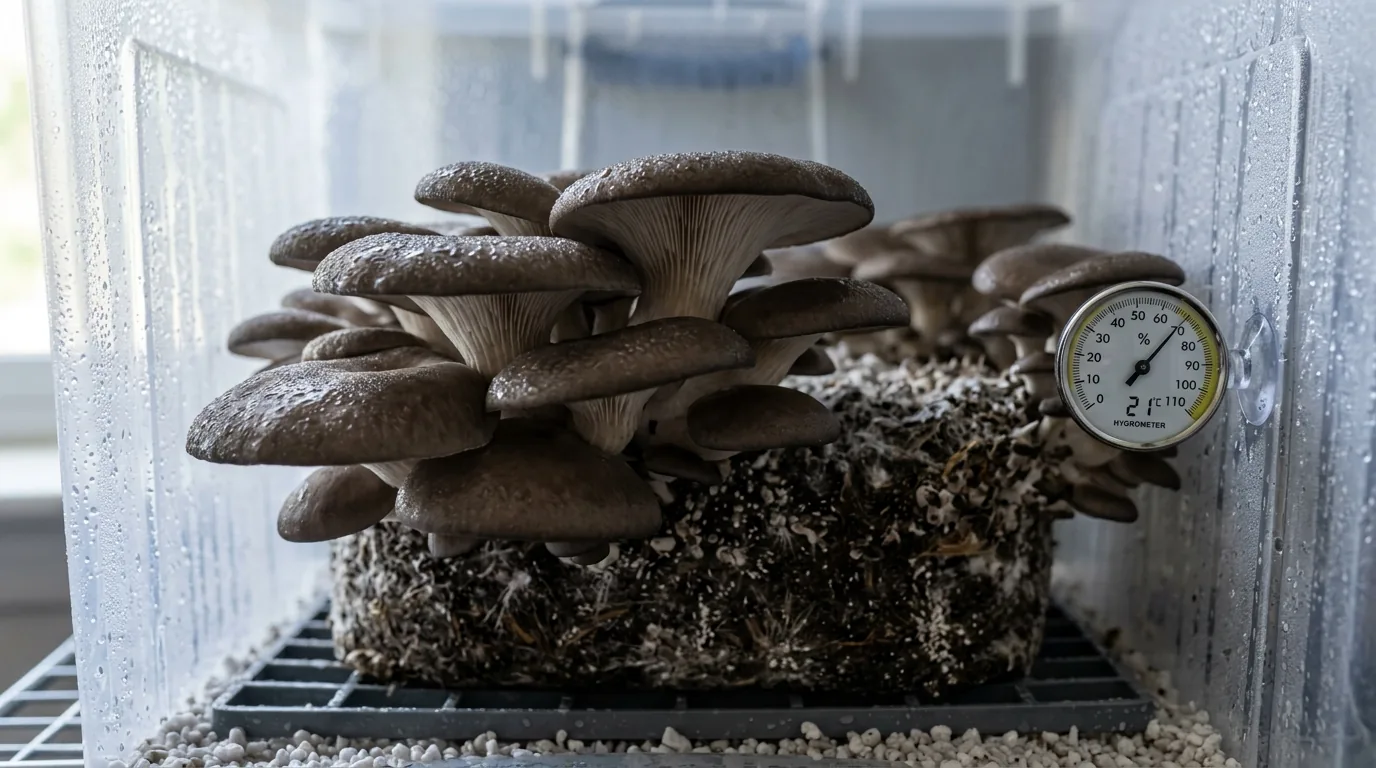
Digital hygrometers are inexpensive and essential. Analog dial types are less accurate. For precise work, a digital probe hygrometer with the probe inside the fruiting chamber provides real-time data. Budget $15-30 for a reliable unit.
Humidity gradients exist within a fruiting chamber — the area nearest the substrate surface is more humid than the air higher in the chamber. Measure at mid-height for a representative reading.
Maintaining Humidity
Manual misting: A clean plastic spray bottle with clean water (distilled or RO water is preferred — tap water minerals can leave white deposits on fruits). Mist the walls and air inside the chamber, not directly on fruit bodies. 2-4 times per day is typical in low-humidity environments; less in naturally humid climates.
Automated humidifiers: Ultrasonic cool-mist humidifiers can be automated with a humidity controller (Inkbird or similar) and a hygrometer probe inside the chamber. The humidifier runs until target humidity is reached, then shuts off. This is the most consistent approach for serious growers.
Passive moisture sources: A reservoir of wet perlite in the bottom of a SGFC (shotgun fruiting chamber) provides passive humidity through evaporation. Effective and low-maintenance for small grows.
Sealing and insulation: Well-sealed fruiting chambers lose humidity more slowly. Clear storage totes, modified Martha tents, and commercial fruiting chambers all hold humidity better than open or loosely sealed containers. Foam insulation around tubs reduces temperature-driven evaporation.
Fresh Air Exchange (FAE)
Why FAE Is Critical
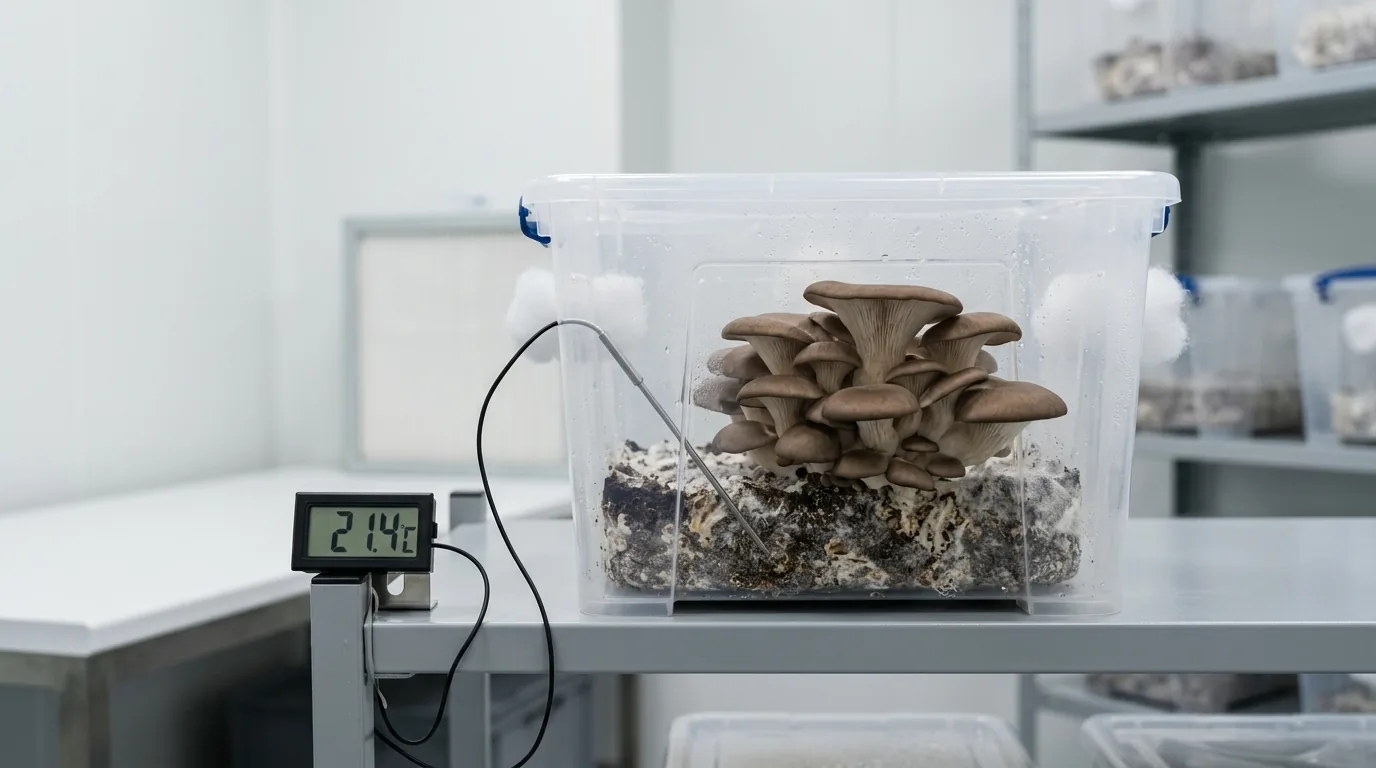
Actively growing mycelium and developing fruit bodies produce carbon dioxide (CO2) as a metabolic byproduct — in amounts that accumulate rapidly in enclosed spaces. Psilocybe cubensis fruit bodies are sensitive to CO2 concentration:
Normal atmospheric CO2: ~400 ppm High CO2 levels in enclosed chambers: Can exceed 2,000-5,000+ ppm Effect of high CO2 on fruiting: Stems elongate abnormally; caps remain small and underdeveloped; abort rates increase; fruit bodies "reach" upward toward fresh air (phototropic plus CO2 gradient response)
The characteristic "alien fingers" or "pins that stretch and never cap" seen in poorly-ventilated grows is almost always a CO2 problem. The solution is not more misting or adjusting temperature — it's more FAE.
FAE Without Drying Out the Substrate
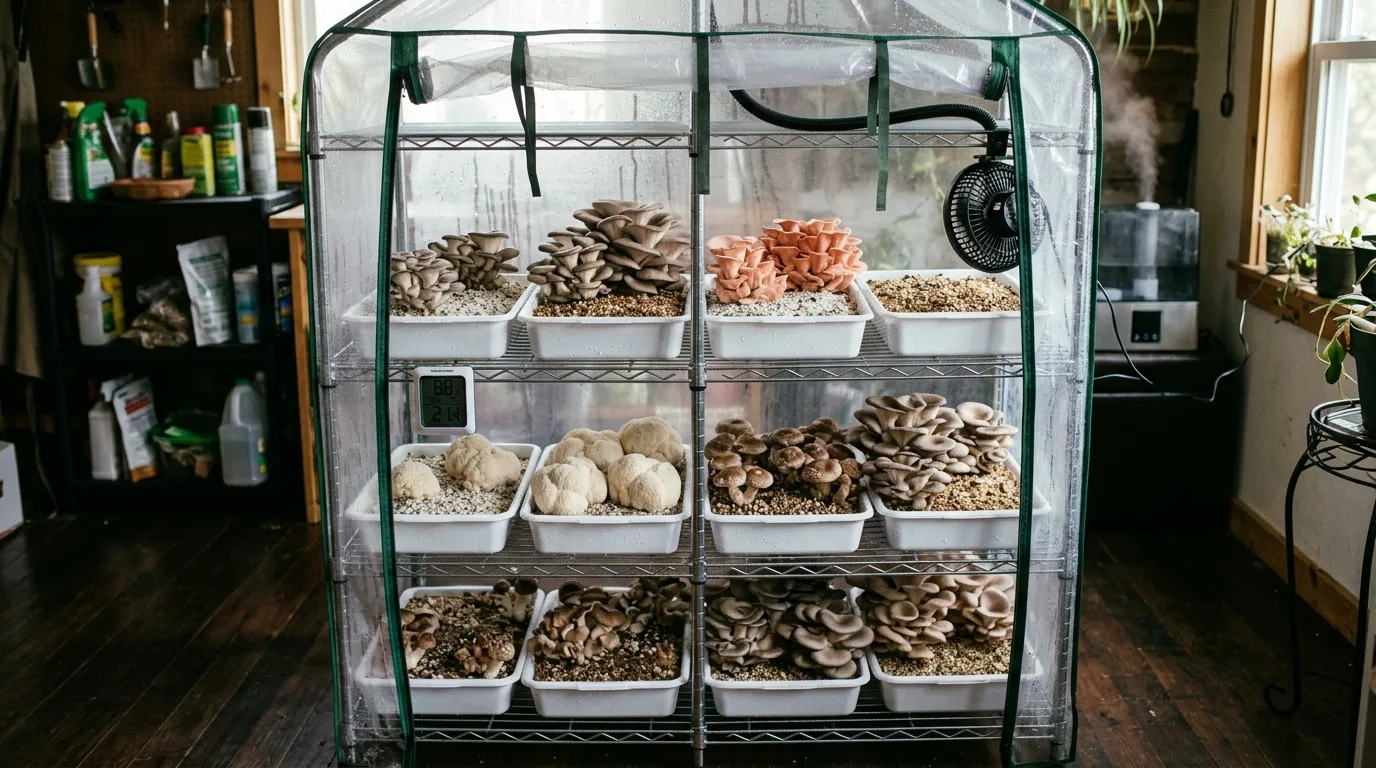
The challenge: each FAE event exchanges humid chamber air for drier room air, dropping relative humidity inside the chamber. Aggressive FAE dries the substrate surface; insufficient FAE causes CO2 problems. The balance is the core fruiting chamber design challenge.
Solutions:
Timing FAE before misting: Fan first, then mist after. The misting restores humidity that FAE removed.
Short, frequent FAE events: Three 30-second FAE events daily dry the chamber less than one 5-minute event while providing similar total gas exchange.
Passive FAE design: SGFC (shotgun fruiting chambers) with many small holes achieve passive FAE without active fanning — the holes allow diffusion-based gas exchange. Passive designs lose humidity faster but require no active management.
FAE timing relative to fruiting stages: Increase FAE during pinset initiation (more CO2 sensitivity); maintain consistent FAE during fruit development; reduce aggressive FAE during the first 24-48 hours after pinning to prevent drying the tiny pins.
FAE Methods
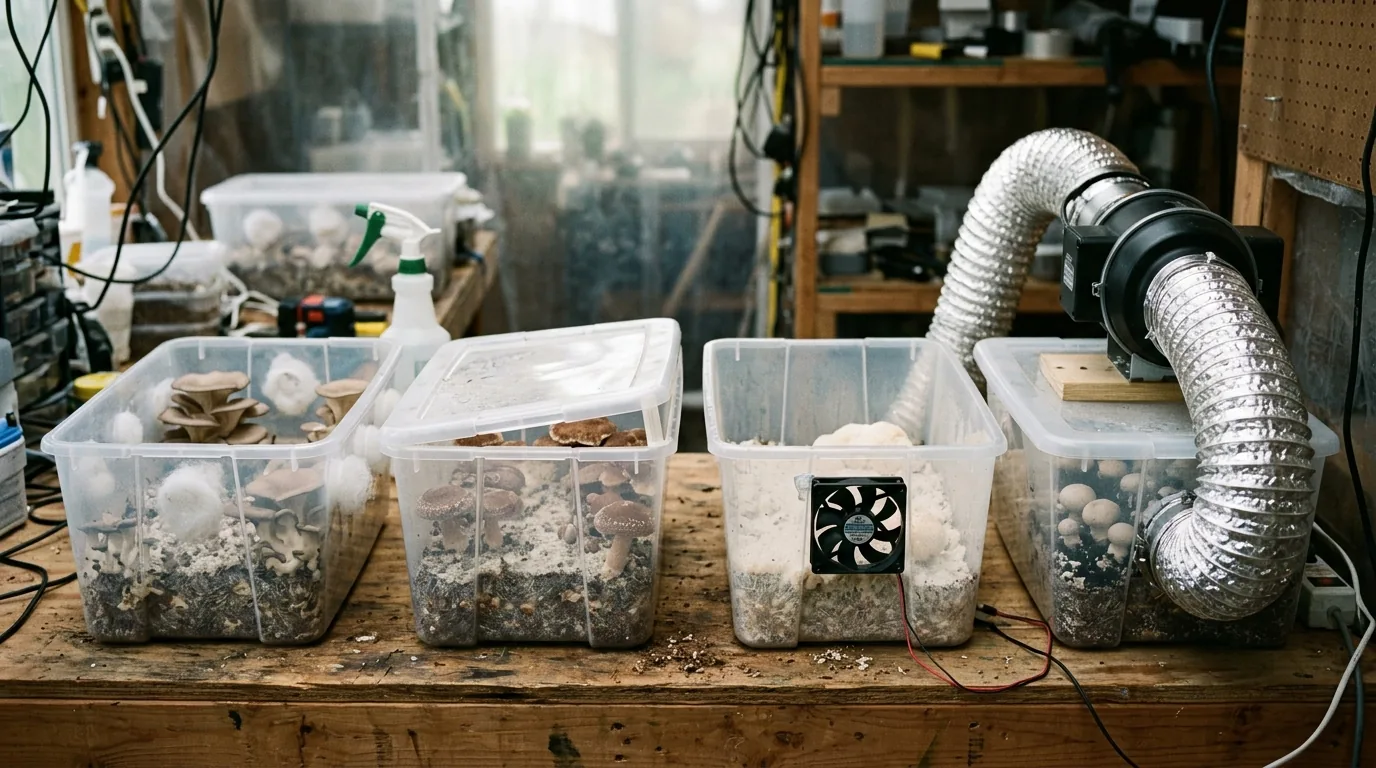
Manual fanning: Open the fruiting chamber and wave a magazine, cardboard, or lid vigorously for 30-60 seconds. Simple, free, effective. Requires scheduling.
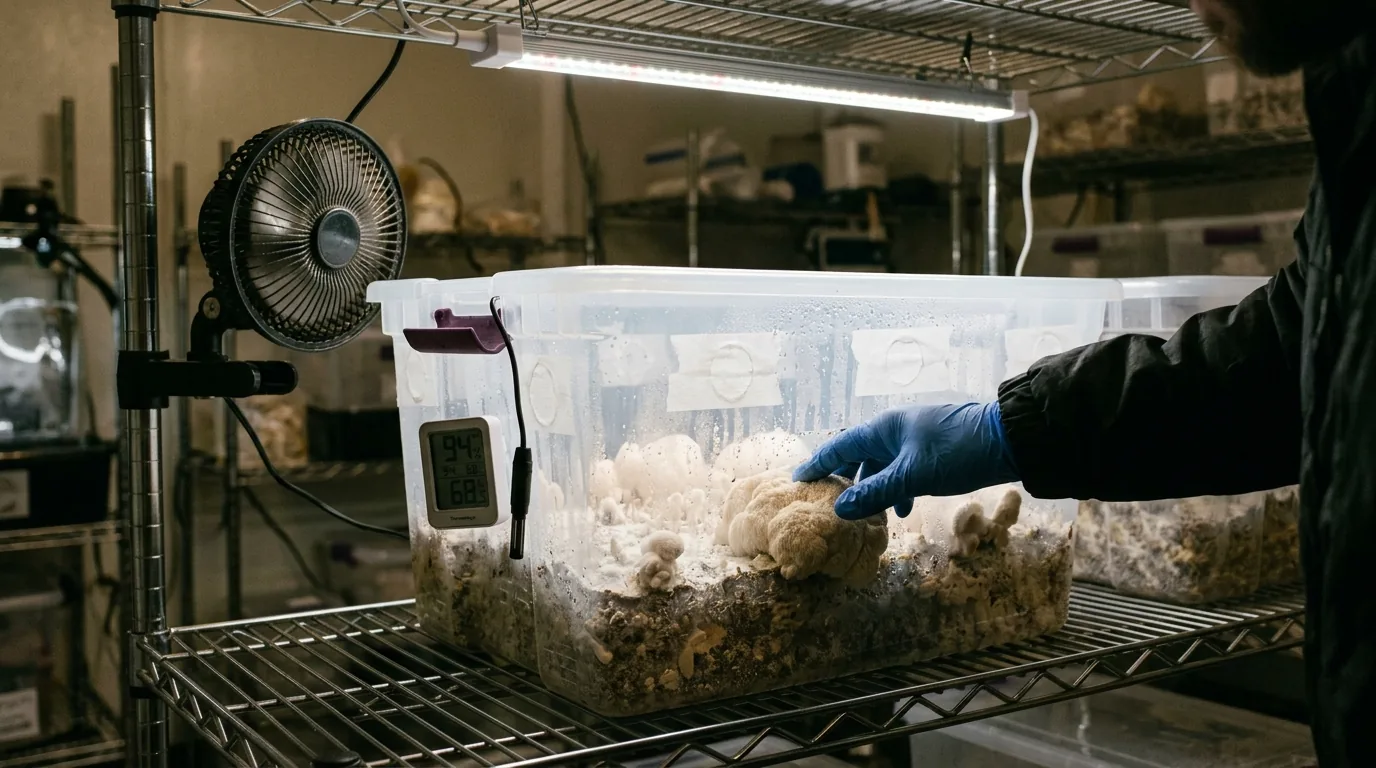
Computer fan with timer: A small PC fan (12V, low CFM) on a timer provides automated FAE without significant airflow that would dry the chamber. Fans can be mounted in holes cut in the chamber lid or walls. A common setup: fan runs for 30 seconds every 4 hours.
Martha tent setups: Modified greenhouse tents (Martha tents) with a humidity controller and an automated fogger create sophisticated environments where FAE is provided through passive hole design or small duct fans, while humidity is maintained automatically.
Putting It Together: The Fruiting Day
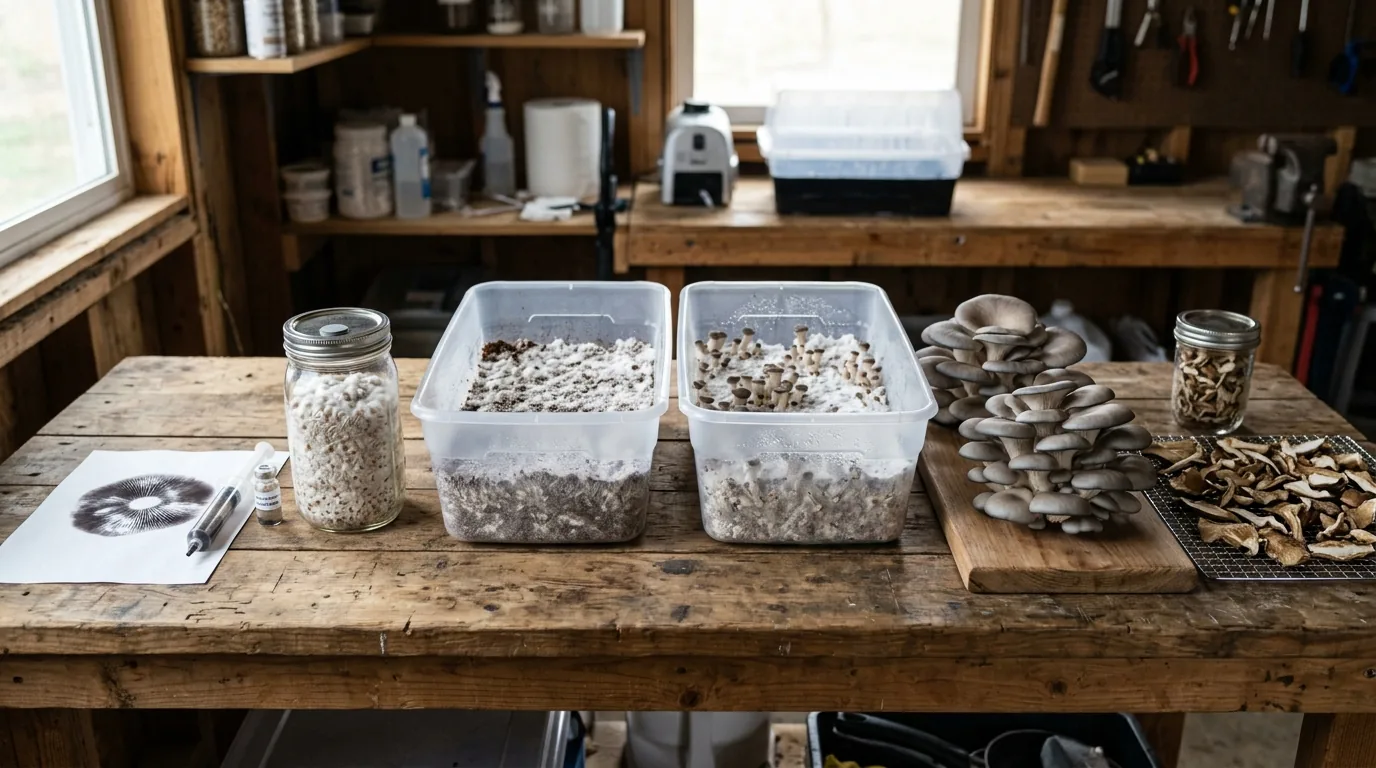
A typical fruiting chamber daily routine at steady state:
Morning:
- Check temperature and humidity readings
- Provide FAE (30-60 seconds)
- Mist walls if humidity is below 88%
- Inspect fruits for development stage, aborts, or contamination
Midday:
- FAE event
- Mist if needed
Evening:
- FAE event
- Mist if needed
- Observe fruiting bodies for harvest readiness (veil status)
Night:
- FAE event (from fan on timer if automated)
- No misting needed while temperature and evaporation are lower
This is the manual routine. Automated setups with humidity controllers and fan timers reduce this to visual inspection twice daily.
Environmental Diagnostics by Symptom
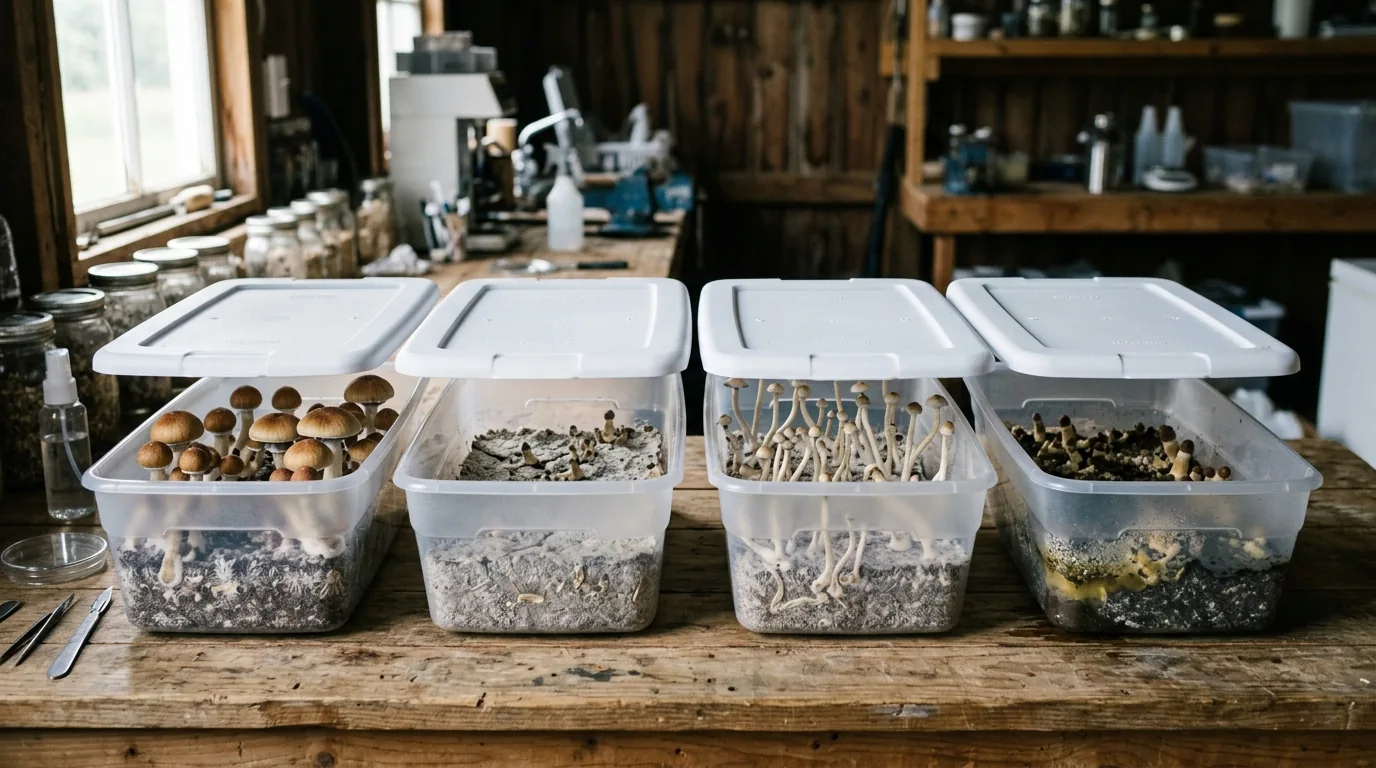
Fruits tall with small caps (leggy growth): Too much CO2 — increase FAE frequency and duration.
Fruit bodies drying out and aborting: Humidity too low — increase misting frequency or improve chamber sealing.
Pins form but don't develop / high abort rate: Could be low humidity OR temperature out of range. Check both.
No pins forming after full colonization: CO2 may be too high (preventing initiation), humidity may be too low, or temperature may need adjustment. Ensure at least 90% RH at the substrate surface, adequate FAE, and temperature in the 70-75°F range.
Bacterial wet rot on substrate: Humidity too high and/or FAE too low. Reduce misting, increase FAE, remove affected material.
Fruits with cracked or dried caps: Humidity dropped during development. Caps crack when they expand faster than surface tissue can maintain moisture. Increase surface humidity during pin development.
Common Problems & Troubleshooting
See the Contamination Guide for common issues.
Tips for Success
Take notes at every stage. Consistency beats perfection.