
How Psilocybin Treats Addiction: The Neuroscience Explained
Psilocybin has shown striking results in clinical trials for smoking cessation, alcohol use disorder, and opioid addiction. The 80% smoking abstinence rate at 6 months in the Hopkins trial is more than double the results of the best conventional treatments. Understanding why this works requires understanding several convergent mechanisms.
Mechanism 1: Disrupting the Default Mode Network
The default mode network (DMN) is a set of brain regions active during self-referential thought — rumination, narrative about yourself, planning, daydreaming. In addiction, the DMN encodes the story of the addicted self: "I am a smoker," "I need a drink to unwind," "This is just how I am."
Psilocybin is one of the most powerful known disruptors of DMN activity. The suppression of DMN coherence under psilocybin creates a window in which habitual self-narratives lose their grip. People describe this as a temporary liberation from the story they have been living. In that window, a different story becomes possible.
Research at Imperial College London showed that the magnitude of DMN disruption under psilocybin correlates with subsequent antidepressant response — and the same mechanism likely explains addiction response. Disrupting the neural substrate of habitual self-narrative enables new patterns to be established.
Mechanism 2: Interrupting Habit Loops
Addiction is maintained by habit loops: cue → craving → behavior → reward. These loops are encoded in the basal ganglia and reinforced by dopamine signaling. They are notoriously resistant to extinction — which is why addiction persists even when the person consciously wants to stop.
Psilocybin's effects on the serotonin 2A receptor appear to modulate the rigidity of these loops. The serotonergic system interacts with dopaminergic reward pathways in ways that are still being mapped, but the effect is one of reduced compulsiveness in habitual behavior patterns. Post-session, people report that the automatic pull of the habit feels less automatic — there is a gap, however brief, between cue and craving.
Mechanism 3: The Mystical Experience and Motivational Transformation
The Hopkins smoking cessation trial found that the strength of mystical experience during the psilocybin session was the single strongest predictor of abstinence at 12 months. This finding has been replicated across multiple addiction and depression trials.
The mystical experience — characterized by a sense of unity, sacredness, noetic quality (feeling of genuine insight), transcendence of time and space — appears to produce a category shift in how the person relates to the behavior. Participants frequently describe their relationship to cigarettes or alcohol as fundamentally changed — not merely that they decided to quit but that quitting became effortless because the desire itself transformed.
This is qualitatively different from most addiction treatment mechanisms, which work on managing craving rather than transforming the underlying motivation. Psilocybin appears to address the motivational structure itself.
Mechanism 4: Neuroplasticity and Window for Change
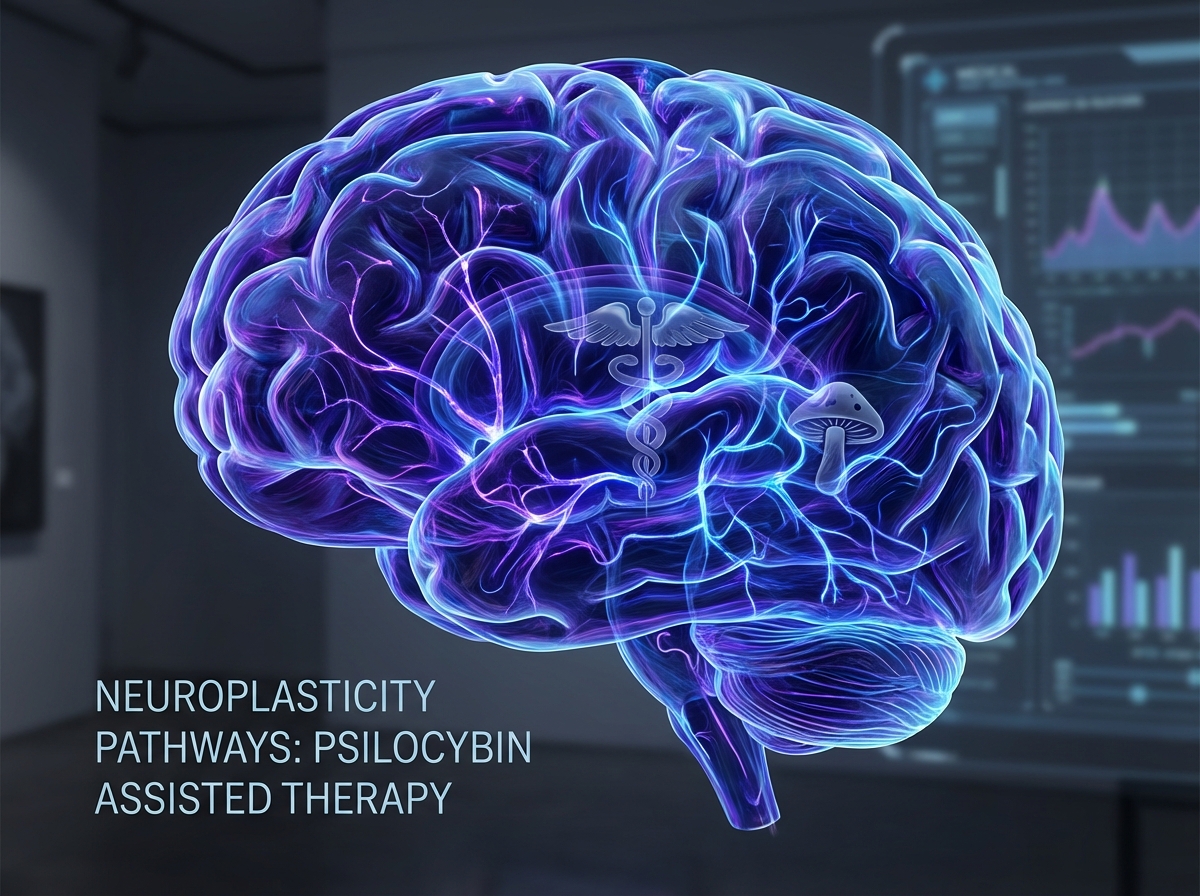
Psilocybin reliably upregulates BDNF (Brain-Derived Neurotrophic Factor) and promotes dendritic spine growth — structural changes in the brain that are the substrate of learning and memory formation. In the days and weeks following a psilocybin session, the brain is in a heightened plasticity state: more capable of forming new associations, breaking old ones, and encoding new behavior patterns.
This is why integration work immediately following a session is therapeutically potent. The neuroplasticity window is not infinite — it diminishes over 2–4 weeks — but during that window, behavioral changes and new habits take root more readily than at baseline.
Clinical Evidence Summary
| Addiction type | Trial | Result | |---------------|-------|--------| | Tobacco/smoking | Hopkins (Johnson et al., 2014) | 80% abstinence at 6 months | | Alcohol use disorder | NYU (Bogenschutz et al., 2015) | 83% reduced drinking days | | Opioid use disorder | Several pilot studies | Early positive signals | | Cocaine use disorder | Research phase | Active trials |

What This Means for Treatment
Psilocybin-assisted addiction treatment is not a single session and done. The clinical protocols that produce these results combine:
- Careful preparation (multiple sessions with a therapist or counselor)
- A well-supported psilocybin session optimized for therapeutic depth
- Integration therapy that builds on what the session initiated
The psilocybin creates the window. The therapeutic work determines what happens in it.