Group Psilocybin Therapy: Evidence and Practice
Most published psilocybin research has used an individual therapy model — one participant, one or two therapists, one session. But group models are gaining traction in both clinical and regulatory contexts. This guide covers the evidence for group...
Group Psilocybin Therapy: Evidence and Practice
Most published psilocybin research has used an individual therapy model — one participant, one or two therapists, one session. But group models are gaining traction in both clinical and regulatory contexts. This guide covers the evidence for group psilocybin therapy, how it differs from individual sessions, and what to expect if you're considering a group format.
Why Group Psilocybin Therapy?
The case for group models is partly practical, partly clinical:
Access and cost: Individual psilocybin therapy is expensive — often $1,000–3,000 per session when facilitator time is included. Group sessions, where multiple participants share a facilitator's time, reduce per-person cost significantly. In Oregon, some service centers offer group sessions at meaningfully reduced rates.
The shared experience effect: There is clinical evidence — and substantial anecdotal support — that the knowledge that others are simultaneously going through a psilocybin experience provides psychological safety and reduces anxiety. You are not alone in the room with something unfamiliar.
Therapeutic relational content: For some conditions — particularly depression characterized by isolation, loneliness, or social disconnection — sharing the space with others and witnessing shared humanity may itself be therapeutic.
Scalability: Group models make it possible to serve larger populations. A single facilitator can support 4–8 participants simultaneously, multiplying the reach of available trained practitioners.
The Johns Hopkins Group Therapy Trials
The most rigorous published data on group psilocybin therapy comes from the Hopkins team's work on alcohol use disorder (2022, Matthew Johnson and colleagues).
Format: Participants received group preparation sessions, individual psilocybin sessions with personal facilitation, and group integration sessions. The psilocybin session itself remained individual — the group elements were in preparation and integration.
Results: Significant reduction in alcohol use at 32-week follow-up, with effect sizes comparable to the best available pharmacotherapy. This compared favorably to the individual therapy model in earlier Hopkins addiction trials.
What this tells us: Group therapeutic work around a psilocybin experience — even if the session itself is individual — can produce comparable outcomes. The community and shared processing elements contribute meaningfully.
Fully Group Psilocybin Sessions
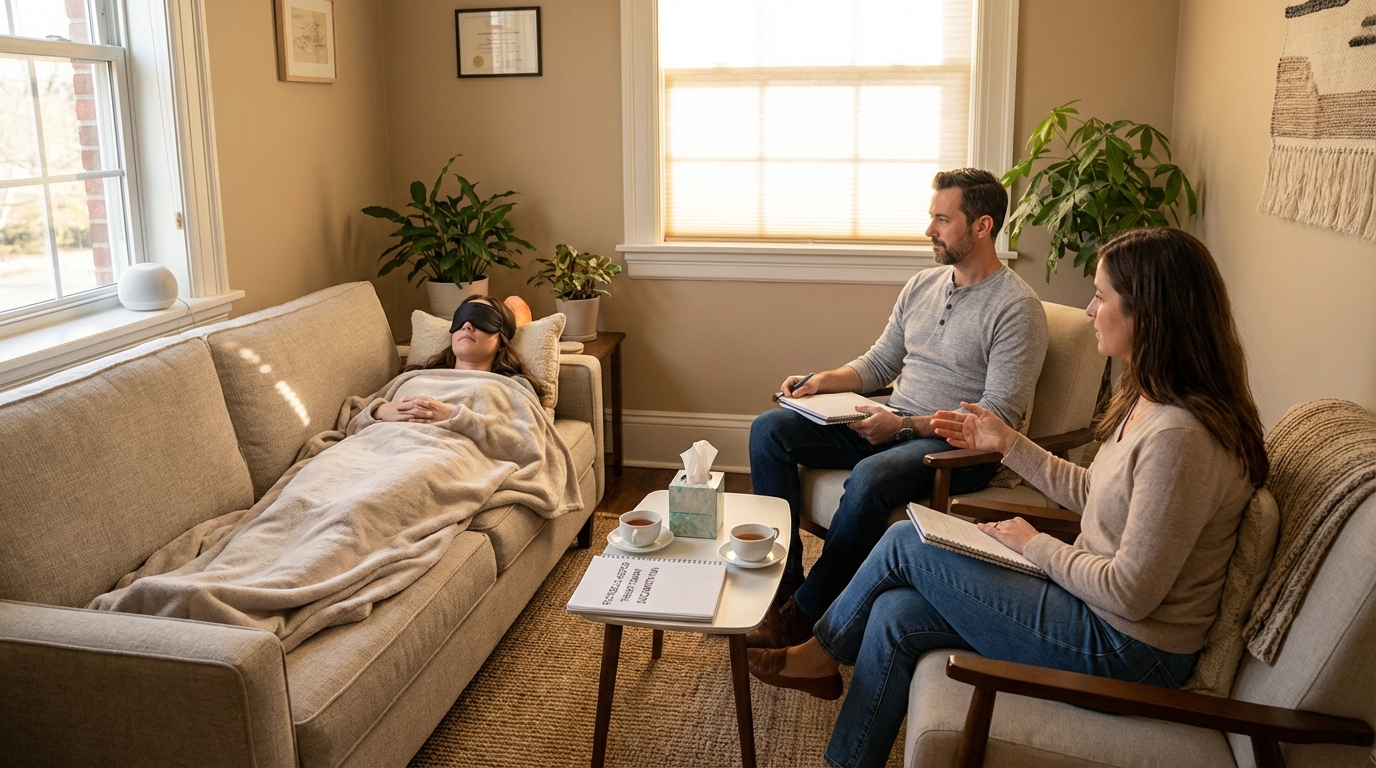
Some clinical programs and many legal service centers have moved toward fully group psilocybin sessions — multiple participants dosing simultaneously in the same space, with facilitators moving between participants as needed.
Structure of a typical group session:
- 4–8 participants recline or lie on separate mats or beds in the same room, spaced for privacy
- Each participant wears an eye mask and headphones playing individual music (or shared music through speakers)
- 1–2 facilitators are present, moving quietly between participants to check in and offer support
- Minimal talking during the session — participants are invited inward
- Group sharing circle after the session: participants share their experience with each other, often for 60–120 minutes
Evidence on the shared experience: Phenomenological research on group psilocybin sessions has found that participants often report awareness of and connection to others in the room even when eyes are closed — a kind of shared field. This effect, difficult to study rigorously, is reported as meaningful by many participants.
Differences from Individual Sessions
| | Individual | Group | |--|--|--| | Facilitator attention | Continuous, focused | Divided among participants | | Privacy | Complete | Reduced — shared space | | Cost | Higher | Lower per person | | Integration structure | Personal | Shared plus personal | | Facilitator relationship | Deep one-on-one | More distributed | | Setting | Usually clinical/home | Usually dedicated group space |
When individual is better: For sessions working with severe trauma, intensive PTSD, or highly sensitive personal material, individual facilitation with full therapist attention is generally preferable to group format. The facilitator cannot monitor one participant closely while managing a group.
When group is well-suited: For general wellness, existential exploration, first experiences with lower doses, and conditions like addiction or depression where the relational element of shared experience is itself therapeutic.
Oregon Group Sessions in Practice
Several Oregon licensed service centers offer group sessions. The OHA (Oregon Health Authority) permits group facilitation with licensed facilitators. Formats vary:
- Day retreats: 6–8 hour sessions, 4–6 participants, shared meal before and after
- Overnight retreats: Sessions conducted in residential settings with overnight integration
- Weekend programs: Two-day formats with preparation day 1, session day 2, integration session day 3
Costs in Oregon group settings typically range $400–900 per person for the session, compared to $1,200–2,500 for individual sessions.
What to Expect in a Group Session
Before: Group preparation session (often 2–3 hours) where all participants meet, share intentions, and become comfortable with each other and the space. This preparation relationship is part of the container.
Arrival: Typically a shared meal, tea, or quiet grounding period. Participants settle into their individual spaces — mat, pillow, blanket.
Dosing: Participants dose simultaneously or in a close window. There is often a brief group intention-setting ritual.
Session: 5–6 hours, mostly silent. Each participant has a private inner experience while sharing physical space. Facilitators are present but minimally intrusive.
Integration circle: After the experience has lightened, participants gather to share. This is often described as one of the most meaningful parts of the group format — hearing that others experienced similar things, witnessing different responses to the same experience, feeling less alone.
Follow-up: Integration sessions are typically individual and scheduled within the following week.
Considerations Before Choosing Group Format
- Privacy needs: If your work involves sensitive personal history you wouldn't want to discuss in a group, consider individual facilitation or ensure the group integration circle is structured appropriately
- Experience level: Group formats are generally better suited to participants who have some familiarity with psilocybin effects — a first high-dose experience in a group setting can be challenging without individual facilitator attention
- Facilitator ratio: Confirm the facilitator-to-participant ratio. Below 1:4 is preferable; 1:8 or more with vulnerable populations is inadequate
- Integration structure: Ask about the integration sessions — group only, individual only, or both? This matters for processing complex material
Resources
- Oregon Health Authority (OHA): Licensing database includes group-format service centers
- Johns Hopkins Center for Psychedelic Research: Published research including group therapy outcomes data
- COMPASS Pathways Group Protocol: Clinical format documentation for the COMP360 Phase 3 trials
- Françoise Bourzat, Consciousness Medicine: Chapter on group ceremonial formats